Morocco’s understated capital, where Almohad ramparts, French-era boulevards and Atlantic light meet in unhurried elegance.
Rabat does not announce itself. There is no medina chaos pulling you in at the airport exit, no relentless chorus of “come look, my friend” along the walls. Instead, the Moroccan capital reveals itself slowly: wide French-planned avenues give way to ochre ramparts, a 12th-century minaret rises over a garden of stumped columns, and the Atlantic wind moves through a blue-and-white kasbah perched above the river mouth. Rabat has been the seat of power since 1912, but its bones go back to an Almohad sultan’s unfinished dream of building the greatest mosque in the Muslim world.
“Rabat is the Morocco you discover once you stop looking for spectacle and start noticing quiet.”
What Makes Rabat Special
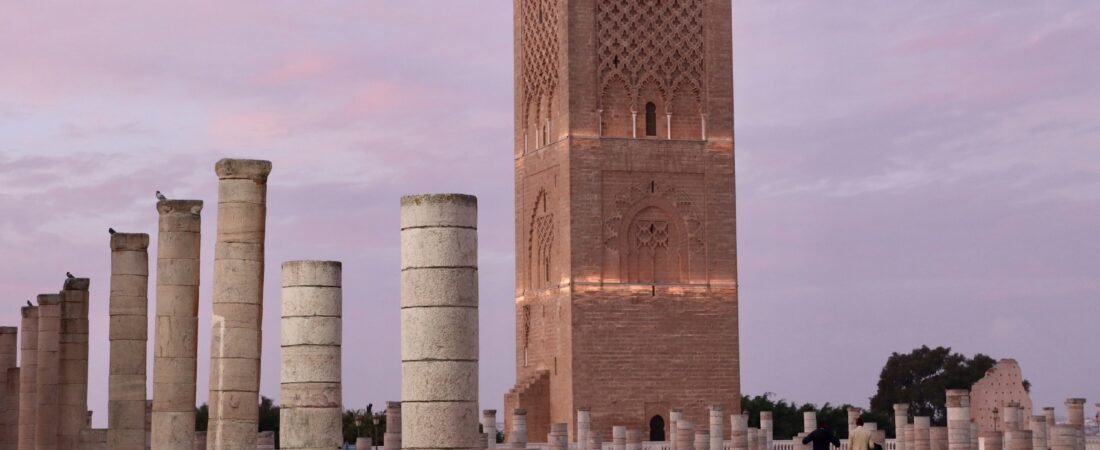
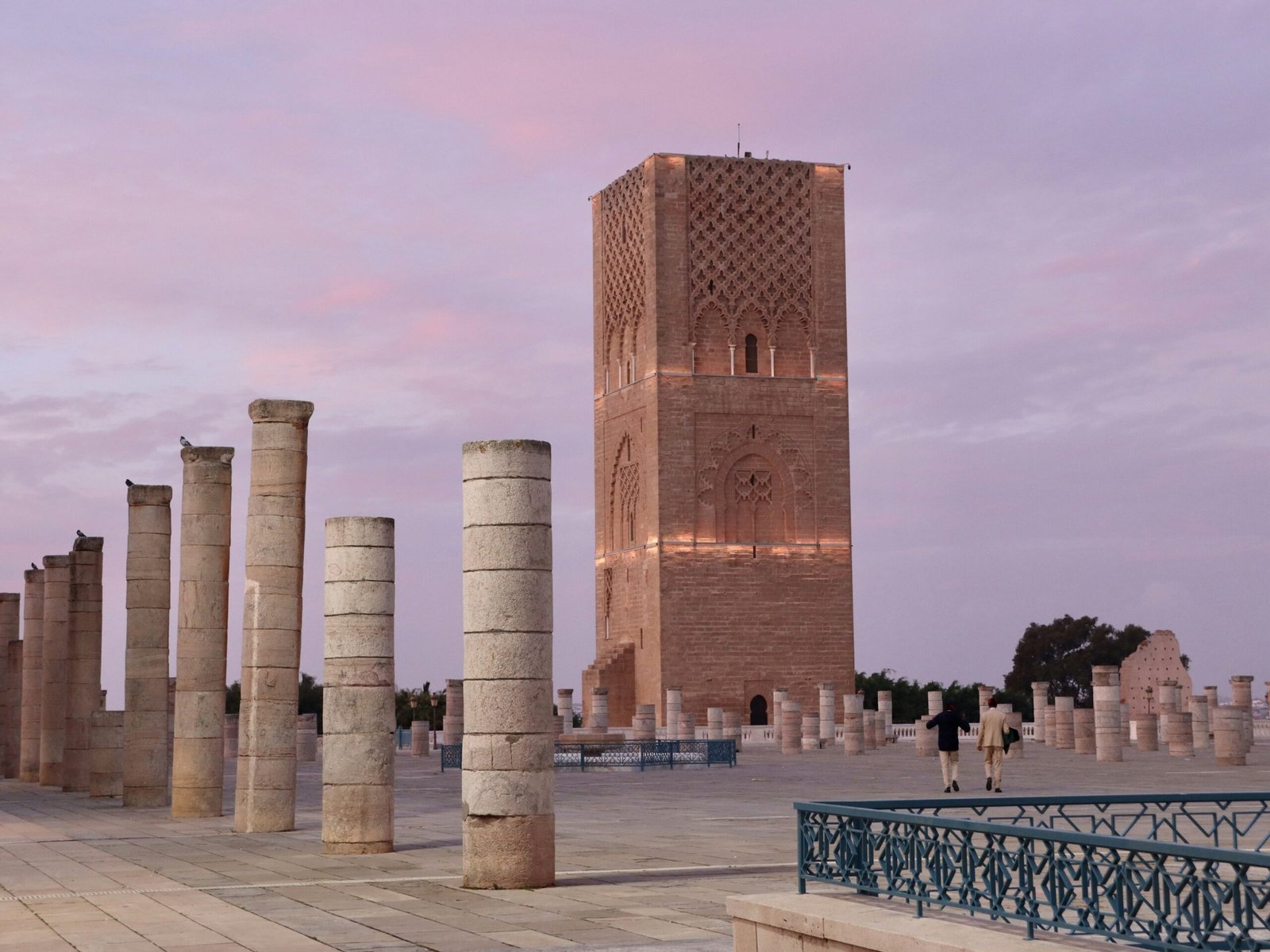
Rabat’s story begins with the Almohad caliph Abd al-Mu’min, who built a fortified ribat here in the 1150s as a staging post for campaigns against Christian forces in Iberia — the origin of the name Ribat al-Fath, “the camp of victory.” His grandson, Yaqub al-Mansur, later dreamed bigger: a mosque intended to rival any building on earth, its minaret meant to be the tallest of its era. When al-Mansur died in 1199, work stopped almost overnight. What remains is the Hassan Tower, standing 44 meters tall over the stone stumps of 348 unfinished columns — one of the most haunting ruins in North Africa, and a rare monument to ambition arrested mid-thought.
For centuries afterward Rabat stayed a relatively modest port town, eclipsed by Fez and Marrakech as centers of power, while pirates and corsairs known as the Sale Rovers operated from the mouth of the Bou Regreg river below the Kasbah of the Udayas. Everything changed in 1912, when the French Protectorate moved the capital from Fez to Rabat and commissioned the urban planner Henri Prost to lay out a new administrative city alongside the old one. Prost’s wide boulevards, roundabouts, and government buildings still frame the modern center today, sitting in close, deliberate conversation with the historic medina, kasbah, and royal palace. It is this pairing — a functioning 20th-century capital built directly beside its own medieval core — that earned Rabat its UNESCO World Heritage inscription in 2012 as “Rabat, Modern Capital and Historic City: a Shared Heritage.”
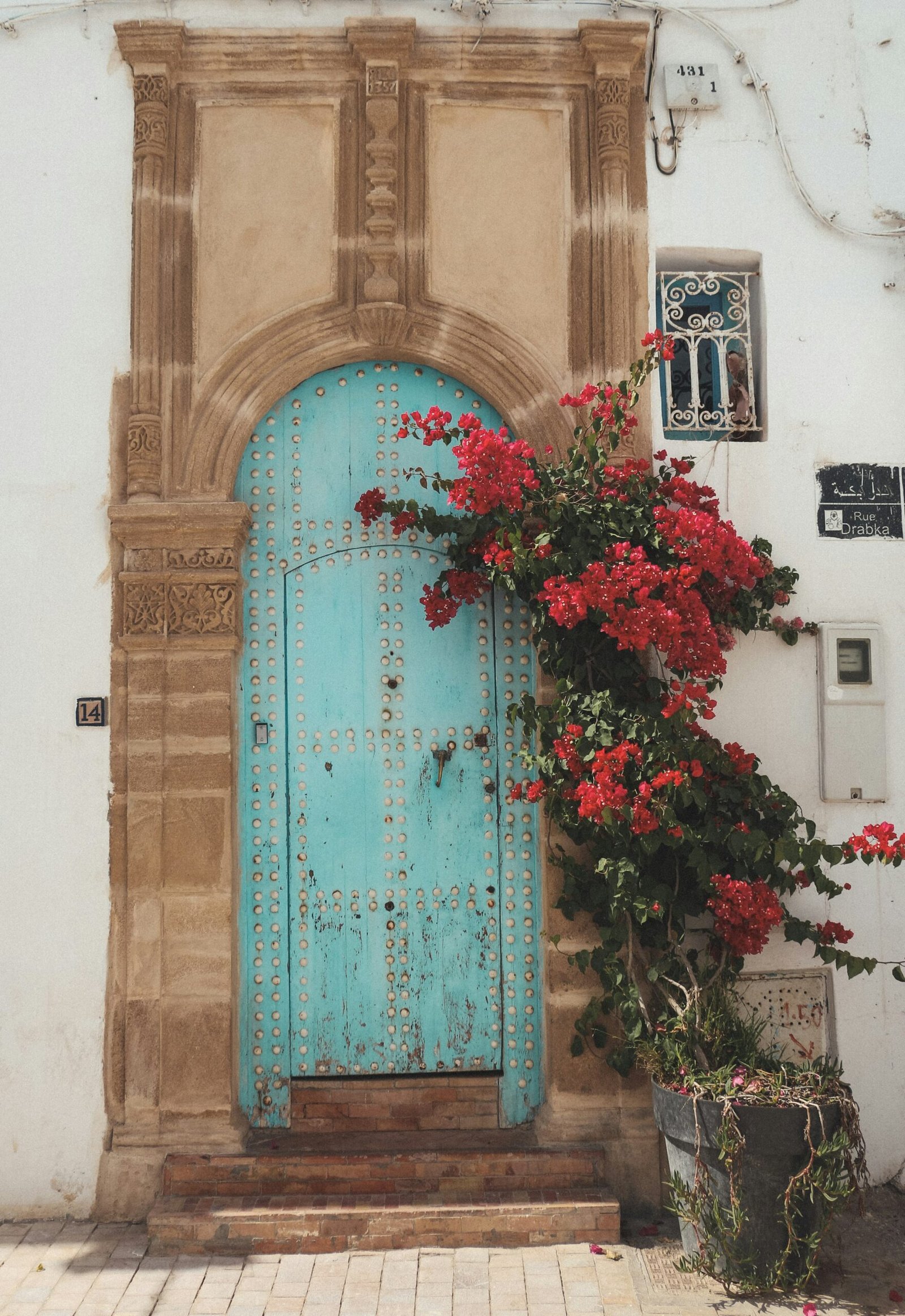
What travelers notice first is the pace. Rabat is a city of civil servants, diplomats, and students rather than souvenir touts, and it wears its history with less performance than Marrakech or Fez. Cafes spill onto tree-lined streets, the tram glides past the royal palace walls, and at the Kasbah of the Udayas, whitewashed and cobalt-blue lanes drop toward an Andalusian garden and a clifftop view of the Atlantic. A short walk away, the ruins of Chellah — a Roman settlement called Sala Colonia, later a Merinid royal necropolis abandoned around 1150 — sit wrapped in fig trees and storks’ nests, one of the most atmospheric ruins in the country.
Top Things to Do in Rabat
- 01
Hassan Tower & Mausoleum of Mohammed V
Stand among the 348 stone columns of Yaqub al-Mansur’s unfinished 12th-century mosque, then cross to the mausoleum of Mohammed V, an ornate marble monument to Morocco’s modern royal history, guarded around the clock by the Royal Guard.
- 02
Kasbah of the Udayas
Wander the blue-and-white lanes of this clifftop fortress above the Bou Regreg, then step into the tranquil Andalusian Garden before taking in Atlantic views from the ramparts.
- 03
Chellah Necropolis
Explore the walled ruins of Roman Sala Colonia and the later Merinid royal necropolis, where crumbling minarets and stork nests sit among fig and banana trees.
- 04
Royal Palace (Mechouar)
Walk past the imposing gates and ceremonial courtyard of the King’s official residence — not open inside, but an essential stop for its scale and the guards in traditional dress.
- 05
Rabat Medina & Mohammed VI Museum of Modern Art
Shop for leather and ceramics in a medina that is calmer than Fez or Marrakech’s, then cross to Morocco’s flagship contemporary art museum for a change of pace entirely.
Practical Tips
Rabat-Salé Airport (RBA) has limited international routes; most visitors fly into Casablanca (CMN) and connect by ONCF train, a comfortable roughly 1-hour ride, with frequent services also from Tangier, Fez, and Marrakech.
Spring (March–May) and autumn (September–November) bring mild, sunny weather. Summers are warm but tempered by the Atlantic; winters are cool and occasionally rainy.
Rabat is relatively liberal and cosmopolitan, but modest, comfortable clothing is still the norm, especially around the palace, mosques, and medina.
Rabat’s tram links the city center with Salé across the river; petit taxis are cheap for short hops, and the compact center, medina, and kasbah are all very walkable.
Final Thoughts
Rabat rewards travelers willing to slow down. It rarely tops must-see lists the way Marrakech or Chefchaouen do, and that is precisely its appeal — a capital where Almohad history, French-era planning, and everyday Moroccan life sit side by side without needing to perform for visitors. Spend a day or two here, between the imperial cities and the coast, and you leave with a quieter, more complete picture of the country.
Keep Exploring Morocco
Planning a longer trip? Browse our full destinations guide for imperial cities, Sahara treks, and Atlantic surf towns.