Where the Mediterranean meets the Atlantic, and Africa leans in close to touch Europe.
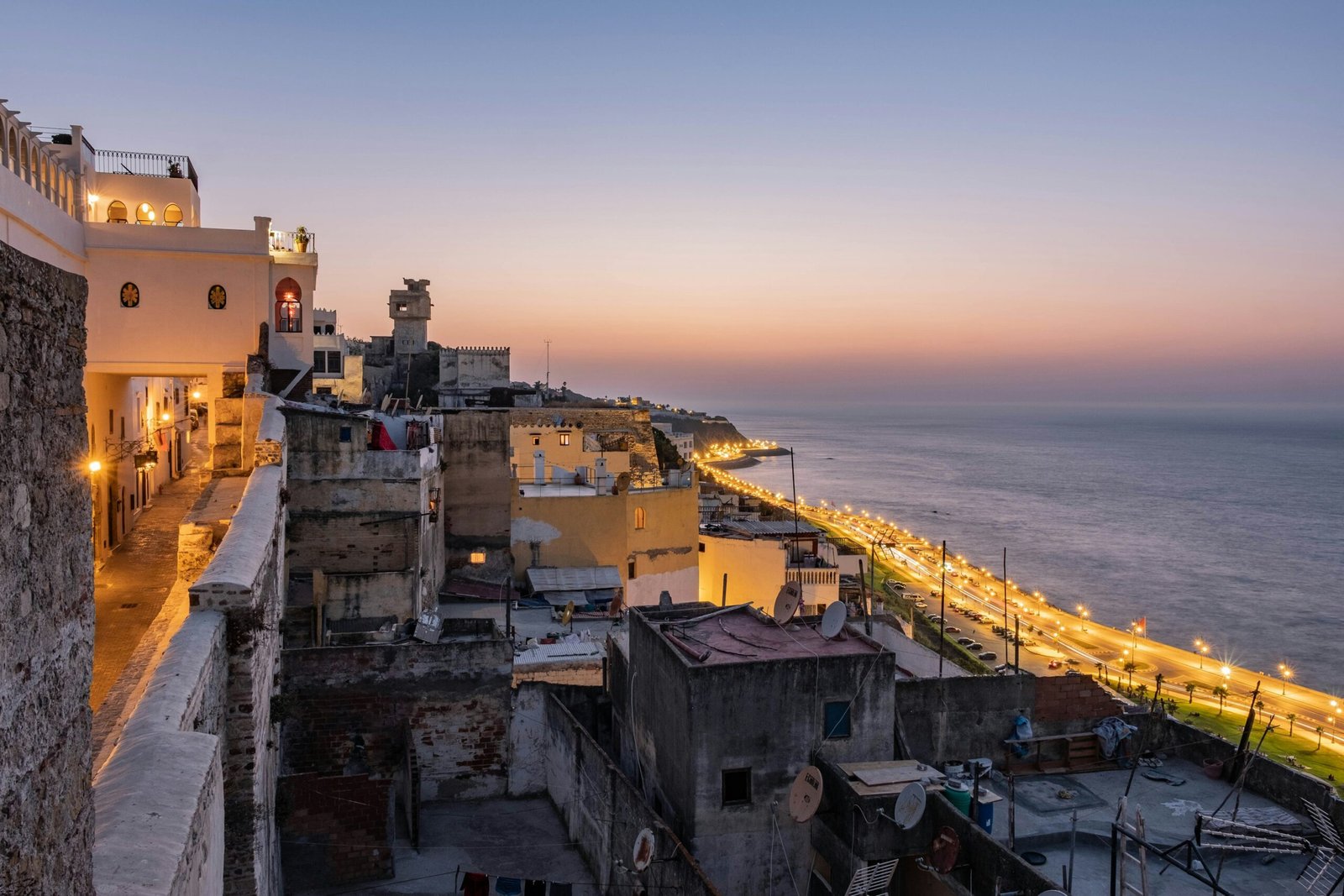
Stand at the top of the Kasbah at dusk and you can watch two seas argue over the horizon: the green swell of the Atlantic pushing against the calmer blue of the Mediterranean, with the hills of Spain visible on a clear day, close enough to feel like a rumor about to come true. Tangier has always lived in that in-between — not quite Africa, not quite Europe, not quite one thing for very long. It is a port city that has been Phoenician, Roman, Portuguese, Spanish, and briefly its own strange international republic, and it wears all of that history in its narrow medina streets, its faded colonial façades, and the particular, unbothered confidence of a place that has seen everyone come through and stayed itself anyway.
“Tangier is a woman who has been loved by too many men to be faithful to any of them, and yet she remains, somehow, entirely herself.”
What Makes Tangier Special
Tangier’s story begins more than 2,500 years ago, when Phoenician traders established a settlement here, drawn by the same thing that draws everyone: its position at the narrowest crossing between two continents. The Romans later built it into the colony of Tingis, and over the centuries that followed, Tangier passed through Arab, Portuguese, Spanish, and British hands before returning to Moroccan rule. It is also the birthplace of Ibn Battuta, the great 14th-century traveler whose journeys covered more ground than almost any explorer before the modern age — a fitting origin story for a city that has always been a threshold rather than a destination in itself.
The most singular chapter of Tangier’s history is its era as an International Zone, from 1923 to 1956, when the city was jointly administered by a patchwork of foreign powers and operated under its own peculiar rules — low taxes, few restrictions, and a permissiveness that made it a magnet for spies, exiled royalty, smugglers, and artists. It was this atmosphere that drew the American writer Paul Bowles to settle here permanently in 1947, and later pulled in Beat Generation figures like William S. Burroughs, who wrote much of Naked Lunch in a Tangier hotel room. That layered, cosmopolitan restlessness never fully left the city; it still shows up in the mix of languages on the street — Darija, French, Spanish, English — and in a medina that feels lived-in rather than staged for visitors.
Today Tangier is Morocco’s gateway city in the most literal sense: ferries and the high-speed Al Boraq train connect it to Europe and to Casablanca, and its port has grown into one of the busiest in the Mediterranean. But its old center — the whitewashed Medina, the fortified Kasbah, the sloping squares of the Grand and Petit Socco — still moves at a slower, older pace, one best explored on foot with no fixed itinerary.
Beyond the old town, Tangier’s edges are just as compelling. Drive west along the coast and the city gives way to windswept cliffs at Cap Spartel, where the Atlantic and Mediterranean are said to meet, and to the Caves of Hercules, a dramatic sea cave whose main opening has famously eroded into the rough shape of Africa. It is a city that rewards both a slow wander through its covered souks and a half-day escape into the landscape just outside it.
Top Things to Do in Tangier
- 01
Explore the Kasbah Museum (Dar el Makhzen)
Housed in a former sultan’s palace at the top of the Kasbah, this museum traces Moroccan history and art through Andalusian gardens, painted ceilings, and archaeological finds. The terraces outside offer some of the best views over the Strait of Gibraltar in the whole city.
- 02
Wander the Grand Socco and Petit Socco
The Grand Socco is the lively square where the modern city meets the old Medina, ringed by cafés and the Cinema Rif. Follow the narrow lanes down to the Petit Socco, once the literary and social hub of International Zone-era Tangier, still lined with old cafés where the pace of conversation has not changed much in decades.
- 03
Visit the American Legation Museum
Tucked into the Medina, this was the first American public property outside the United States and remains the only U.S. National Historic Landmark located abroad. Morocco was the first country to formally recognize American independence, and the museum’s rooms tell that two-century relationship through art, documents, and period furnishings.
- 04
Drive out to Cap Spartel and the Caves of Hercules
A short trip west of the city brings you to the lighthouse at Cap Spartel, perched where the Atlantic and Mediterranean currents meet, and on to the Caves of Hercules, a sea cave whose ocean-facing opening has eroded into a shape resembling the map of Africa.
- 05
Sip mint tea at Café Hafa
Terraced above the sea since the late 19th century, this cliffside café was a favorite haunt of Paul Bowles, the Rolling Stones, and generations of Tangier writers and musicians. Order a glass of mint tea, find a low stool facing the water, and let an hour disappear.
Practical Tips
Ibn Battouta Airport (TNG) has direct flights from several European cities. Tangier is also reachable by ferry from Tarifa or Algeciras in Spain (about 1 hour), and by the Al Boraq high-speed train from Casablanca and Rabat.
The Medina and Kasbah are best explored on foot — many lanes are too narrow for cars. Petit taxis (blue in Tangier) are inexpensive for longer distances; agree on the fare or ask for the meter before you get in.
The Moroccan dirham (MAD) is the local currency; cards are widely accepted in hotels and restaurants, but carry cash for the Medina. Darija (Moroccan Arabic), French, and Spanish are all commonly spoken, alongside English in tourist areas.
Tangier is generally safe for travelers, including solo visitors. As in any port city, keep an eye on belongings in crowded souks and agree on prices for taxis and guides in advance.
April, May, late September, and October bring mild temperatures and good light for walking the Medina without the summer heat or winter rain.
Final Thoughts
Tangier does not ask to be figured out in a day. It is a city built from overlapping histories — Phoenician traders, Roman colonists, international spies, wandering writers — and it still holds all of that in its winding medina lanes and terraced cafés above the strait. Spend an afternoon getting lost between the Grand Socco and the Kasbah, watch the ferries cross toward Spain from Cap Spartel, and you start to understand why so many people who meant to pass through Tangier ended up staying much longer than planned.
Keep Exploring Morocco
Planning a longer trip? Browse our full destinations guide for imperial cities, Sahara treks, and Atlantic surf towns, or explore more activities across the country.